

Mental well-being isn’t exactly a comfortable conversation topic in most Kenyan workplaces. It’s often brushed aside, treated as taboo, or addressed only when things have already gone wrong. The problem with that approach is that by the time companies step in, they’re usually treating symptoms rather than tackling root causes.
The average person will spend roughly 90,000 hours of their lifetime at work. If that environment lacks proper mental well-being support, it becomes a breeding ground for stress, burnout, and deteriorating mental health.
In today’s guide, we examine eight mental well-being best practices that employers can implement to create healthier and more productive workplaces.
Why Should Mental Well-being Be a Business Priority?
Mental health is a workforce-wide challenge that no business can afford to ignore.
Over 65% of employees now show signs of burnout, according to the World Economic Forum (WEF).
Another Ipsos survey across 31 countries found that 45% of people named mental health as their top health concern, ranking it above cancer and obesity.
Meanwhile, Gallup (PDF) reports that 48% of sub-Saharan workers experience high stress daily, over a quarter feel sad, and one in four struggles with loneliness.
So far, we know for a fact that mental health at work is a topic businesses cannot escape. Many employees are already grappling with it in one way or another.
What happens when these concerns go unchecked?
Globally, depression and anxiety lead to 12 billion lost working days each year. That costs the world economy $ 1 trillion in lost productivity, according to the World Health Organization.
Closer to home, Kenya lost Ksh 62.2 billion in 2021 due to mental health issues among workers, based on the National Guidelines on Workplace Mental Wellness.
Most of these losses were not due to medical expenses but productivity gaps.
- 49% came from absenteeism, where employees missed work because of stress, depression, or burnout.
- 30% came from presenteeism, where employees were present but not performing at their best.
- Only 9% of the total cost went to treatment.
Ignoring mental well-being won’t just hurt employees. It will cost business performance, team productivity, and ultimately, your revenue.
What is the Employer’s Role in Workplace Mental Well-being?
The World Health Organization identifies several workplace factors that directly threaten employee mental health.
The list is long, but it’s worth paying attention to because chances are, your organization is dealing with at least a few of these.
- Underutilized skills or a lack of skills needed for the role
- Excessive workloads, fast-paced environments, or understaffing
- Long, inflexible hours and a lack of control over work schedules
- Unsafe or poor physical working conditions
- An organizational culture that enables negative behaviors
- Limited support from colleagues or micromanagement from supervisors
- Violence, harassment, bullying, discrimination, and exclusion
- Unclear job roles or responsibilities
- Being under-promoted or over-promoted
- Job insecurity, inadequate pay, or poor investment in career development
- Conflicting demands between work and home life
In other words, many mental health challenges employees face start with how work is designed and managed.
Employers have a central role in addressing this issue.
Legally, Kenyan labor laws require employers to provide safe working conditions, which comprises psychological safety. Ethically, organizations have a responsibility to ensure their practices don’t contribute to harm. And culturally, leadership sets the tone for how mental health is viewed and supported.
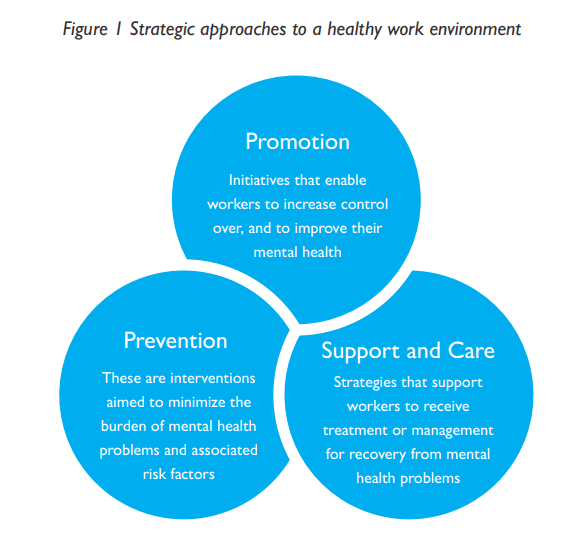
A healthy workplace is not created by accident.
It’s built through intentional decisions about culture and leadership behavior.
Source: Kenyan Ministry of Health
Best Practices for Mental Well-being Programs and Initiatives
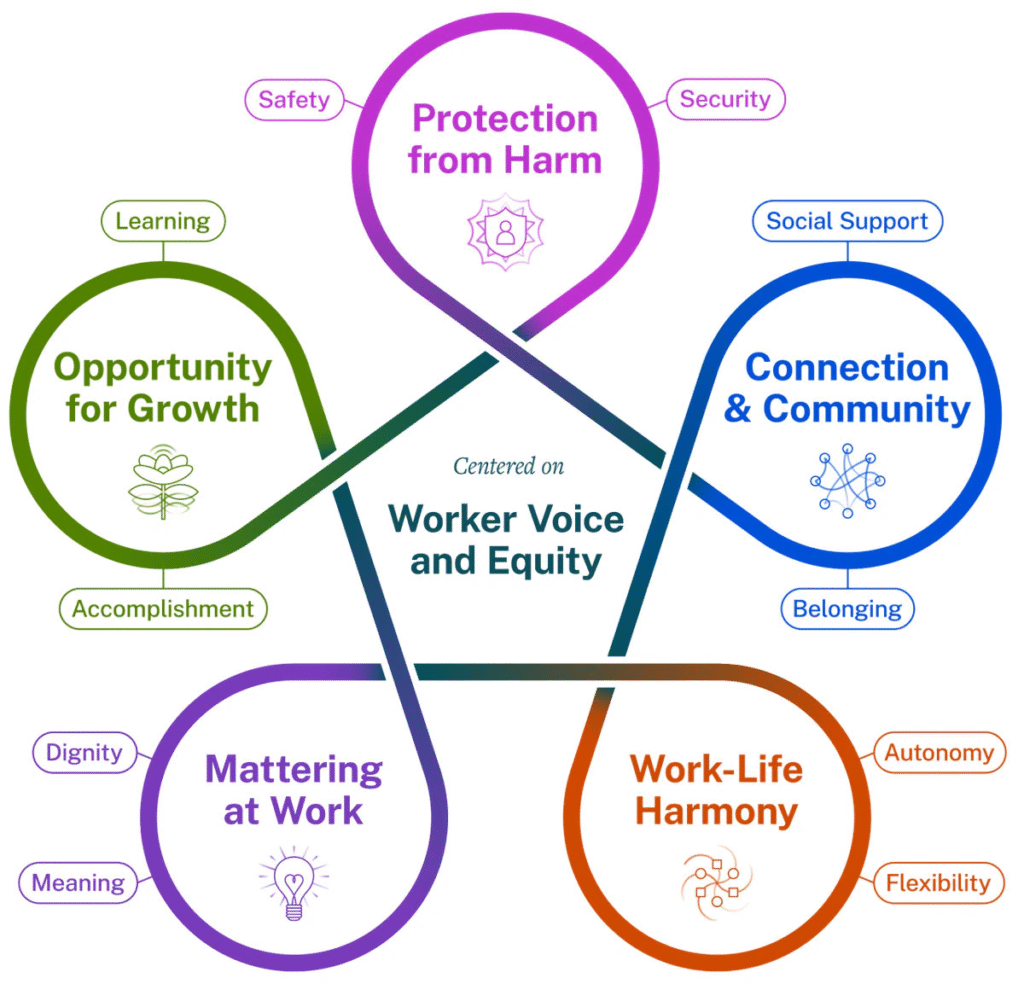
Any mental health program worth implementing should address at least one of five areas: protection from harm, community, work-life balance, dignity at work, and growth opportunities.
Source: US Department of Health and Human Services
1. Train Management and Supervisors to Support Mental Well-Being
Managers play a huge role in shaping how safe and supported employees feel at work. They’re often the first to notice when someone is struggling, but only if they know what to look for and how to respond.
That’s why leadership training on mental health is so important.
A study by the American Psychological Association found that a three-hour mental health training improved leaders’ knowledge, confidence, and willingness to promote psychological well-being.
Organizations that introduced the program also saw a drop in the amount of time employees took off work due to health issues.
Even if you don’t have a lot of resources, investing in a 3-hour mental well-being training for leadership will go a long way.
The training should cover:
- How to recognize warning signs
- How to initiate supportive conversations
- And where to direct employees who need professional help.
Managers should be reminded that checking in on someone’s well-being is part of their role, not an intrusion. However, your business will need proper guidance on when managers should involve HR or escalate concerns.
2. Start a Mental Health Champions Program
Mental health support shouldn’t rest solely on HR or management. Everyone in the organization should play a role in creating psychological safety, thereby building a culture where people look out for one another.
A Mental Health Champions Program trains selected employees across different departments to recognize signs of mental distress in their colleagues and guide them toward the right support.
These champions aren’t therapists or counselors. They’re peers who know how to have a conversation and where to refer someone who needs help.
The approach is more accessible than you might think.
For example, Unilever successfully trained over 4,000 employees to become mental health champions. These individuals became trusted points of contact within their teams, as they could identify when a colleague was struggling and knew how to respond without judgment.
Champions typically receive training on recognizing warning signs, such as persistent fatigue, withdrawal from team activities, or unusual irritability. They learn basic active listening skills and understand the boundaries of their role.
Most importantly, they know the internal resources available, whether that’s an Employee Assistance Program, HR support, or external counseling services.
The benefit of this model is that it normalizes mental health conversations and gives employees more entry points for support.
It also reduces the burden on managers who can’t be everywhere at once.
3. Increase Flexible Scheduling and Workload Management
It might seem counterintuitive, but giving employees more autonomy over their work actually increases their motivation for work.
Even if you’re not able to have hybrid and remote working options, there’s always a way to bake in flexibility into the workplace. For example, you could:
- Allow employees to adjust their start and end times within agreed limits.
- Give employees flexibility to attend to personal commitments, and then make up the time later.
- Allow shift swaps or staggered schedules where operations permit.
- Encourage results-based performance instead of strict hour tracking.
- Let teams plan workloads collaboratively to balance high-demand periods with lighter ones.
4. Start an Employee Assistance Program (EAP)
Employees’ personal problems don’t stay at home. Financial stress, marital conflict, substance misuse, and family crises all show up at work in the form of distraction, absenteeism, and declining performance.
An Employee Assistance Program provides employees with a confidential means to address these challenges before they escalate.
SHRM describes an EAP as “an employer-sponsored resource designed to help employees tackle personal struggles that might impact their job performance…”
The power of an EAP is that it provides professional support without requiring employees to navigate the system on their own.
Someone dealing with burnout or anxiety doesn’t have to search for a therapist, compare costs, and figure out insurance coverage while already overwhelmed. They can contact the EAP, and the program connects them with the right resources.
EAPs typically offer short-term counseling and access to resources, such as financial advisors or legal consultants. The services are confidential, which is important because many employees may be reluctant to seek help if they believe it will impact their work perception.
For employers, EAPs are an investment because employees will get help early, which reduces the likelihood of prolonged absences or performance issues.
The cost of providing an EAP is often lower than the cost of turnover, lost productivity, and crisis management.
If your organization is too small to run an EAP internally, there are third-party providers that offer customized solutions.
An EAP won’t solve every problem, but it ensures that employees have a resource to turn to when life becomes difficult. That access alone can make the difference between someone managing a mental health challenge and being consumed by it.
5. Offer Free or Discounted Professional Counseling for Your Workforce
HR can listen, show empathy, and point people in the right direction, but they can’t provide clinical support.
What employees need is trained counselors and psychologists who can diagnose and guide them through mental health challenges.
If your organization has the capacity, partnering with mental health providers to offer free or subsidized counseling is one of the most direct ways to provide support. This might involve contracting with a local counseling center to offer a set number of sessions per employee annually, or negotiating group rates that make therapy more affordable.
At a minimum, your health insurance should cover mental health treatment.
6. Give Employees a Mental Health Day
Mental health is health. This shouldn’t be a radical statement, but in practice, most workplaces don’t treat it that way.
Employees can take sick leave for the flu without question, but taking a day off because they’re burned out feels like something they need to justify or hide.
A mental health day is a designated time off specifically for rest, recovery, and mental well-being.
It’s separate from annual leave and sick leave, though it serves a similar purpose. The difference is in the recognition. Creating a specific category for mental health days signifies that psychological well-being is just as important as physical health.
Some organizations offer one or two mental health days per year on top of existing leave policies, while others build them into their overall leave structure but make it clear that mental health is an acceptable reason to use that time.
Either approach works, as long as employees feel they can actually use the benefit without judgment.
7. Establish a Formal Mental Health Policy
You can offer counseling, train managers, and create mental health days, but if there’s no formal policy backing these efforts, they’ll remain fragile and inconsistent.
A mental health policy formalizes your organization’s commitment in these three ways:
- Outlines confidentiality protections to ensure employees know their disclosures won’t be shared without their consent.
- Includes non-discrimination clauses that make it clear mental health conditions won’t be used against someone in performance reviews, promotions, or job security decisions.
- Maps out clear processes for seeking support, so employees don’t have to guess who to talk to or what steps to take.
The policy will also protect the organization as it sets boundaries for what managers and HR can and cannot do. This will reduce the risk of well-meaning but misguided interventions.
8. Listen to Your Employees
All these best practices are valuable, but they mean nothing if they’re not grounded in what your employees actually need. Your true north when dealing with mental well-being should always be your workforce.
The most direct way to understand what employees need is to ask them.
You can use anonymous surveys or town halls to create a space for face-to-face dialogue, where employees can raise concerns and see leadership respond in real-time.
Mental Well-being in the Workplace Comes Down to Culture
Your culture determines whether mental health initiatives succeed or fail. You can have policies, programs, and training, but if your culture discourages openness or punishes mistakes, none of these initiatives will succeed.
A supportive culture is one where employees can speak up without fear and when mistakes are treated as learning moments rather than reasons for blame.
Each decision about how you lead, communicate, and respond to challenges influences the mental and emotional well-being of employees.
When you have a culture that supports well-being, both your people and business will flourish.
Bridge Talent Management can help you build culture-driven mental well-being strategies that work for your team and your business. Contact us today to get started.
Faqs
What is mental well-being in the workplace?
Mental well-being in the workplace refers to the psychological and emotional health of employees within their work environment. It encompasses how work conditions, culture, and management practices affect stress levels, job satisfaction, and overall mental health.
What are the factors affecting mental health in the workplace?
According to the WHO, key factors affecting mental health at work include excessive workloads, inflexible hours, poor physical conditions, toxic organizational culture, harassment or discrimination, unclear job roles, inadequate pay, and lack of career development.
How much does workplace mental health cost employers?
In Kenya, mental health issues among workers cost the country Ksh 62.2 billion in 2021, with 49% from absenteeism, 30% from presenteeism, and only 9% from actual treatment costs.
What are the signs that an employee is struggling with mental health?
Warning signs of a struggling employee include persistent fatigue, withdrawal from team activities, and unusual irritability or mood changes.
How can small businesses afford mental health programs?
Small businesses can start with low-cost initiatives, such as mental health training for managers, which research shows significantly improves employee well-being. They can also partner with third-party EAP providers for customized solutions, negotiate group rates with local counseling centers, or implement flexible scheduling at no additional cost.
Contact our HR experts to design a mental health program tailored to your organization’s needs and budget.


